

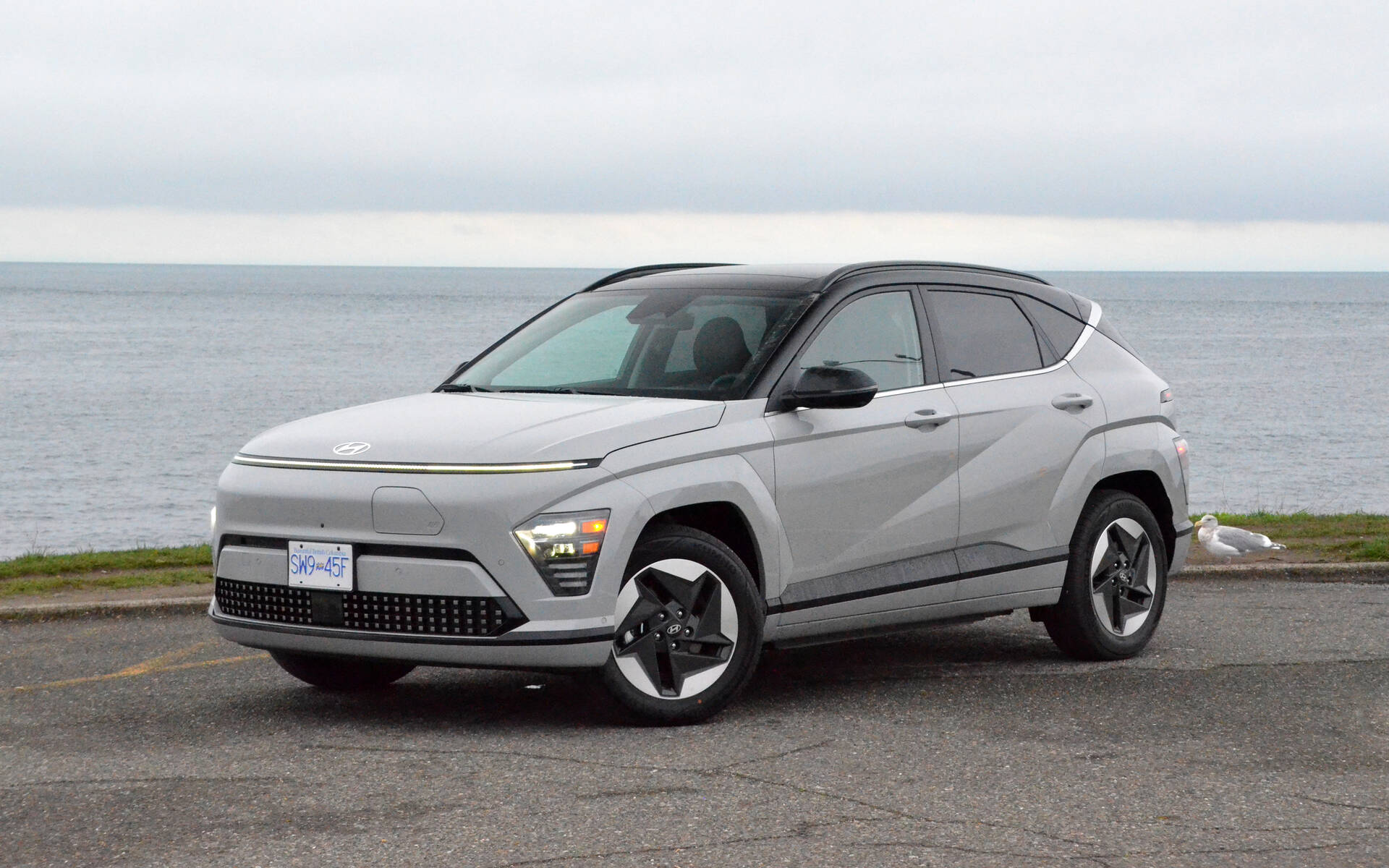
The Hyundai Kona Electric 2024 picks up where it left off and more
Victoria, British Columbia - Hyundai invited a few members of the automotive press to the other side of the country to show them the next-generation electron-powered Kona.
As soon as it was introduced on Canadian soil in 2017 (as a 2018 model), the pocket crossover quickly won praise from the local public, not least thanks to its out-of-the-ordinary looks. We might also add that the automaker has not wavered from its habit of offering equipment-rich vehicles at prices in line with the budget of the average Joe and Jane.
As its public relations department likes to repeat, Hyundai is a brand that listens to its customers. That's why the first-generation range was so extensive: to appeal to the majority. Remember, in addition to the two gasoline variants with naturally-aspirated or turbocharged engines, the manufacturer also offered the first electric Kona just one year after its arrival in the country. Then, as a parting gift, engineers from the sports division transformed the urban SUV into a rubber-burning machine with the Kona N, heavily inspired by the Elantra N.
We're now on the cusp of 2024, and the Korean giant is ready to move on to the second chapter of its electric crossover. We took the wheel of an Ultimate variant - the more expensive of the two available in Canada, the other being the Preferred - on a rainy day in the beautiful region of Victoria, British Columbia. Apart from Quebec, this province is the other place where electric vehicles are very popular in Canada, especially as they are also subject to government rebates.

Make way for the electric Kona 2024!
A matter of design
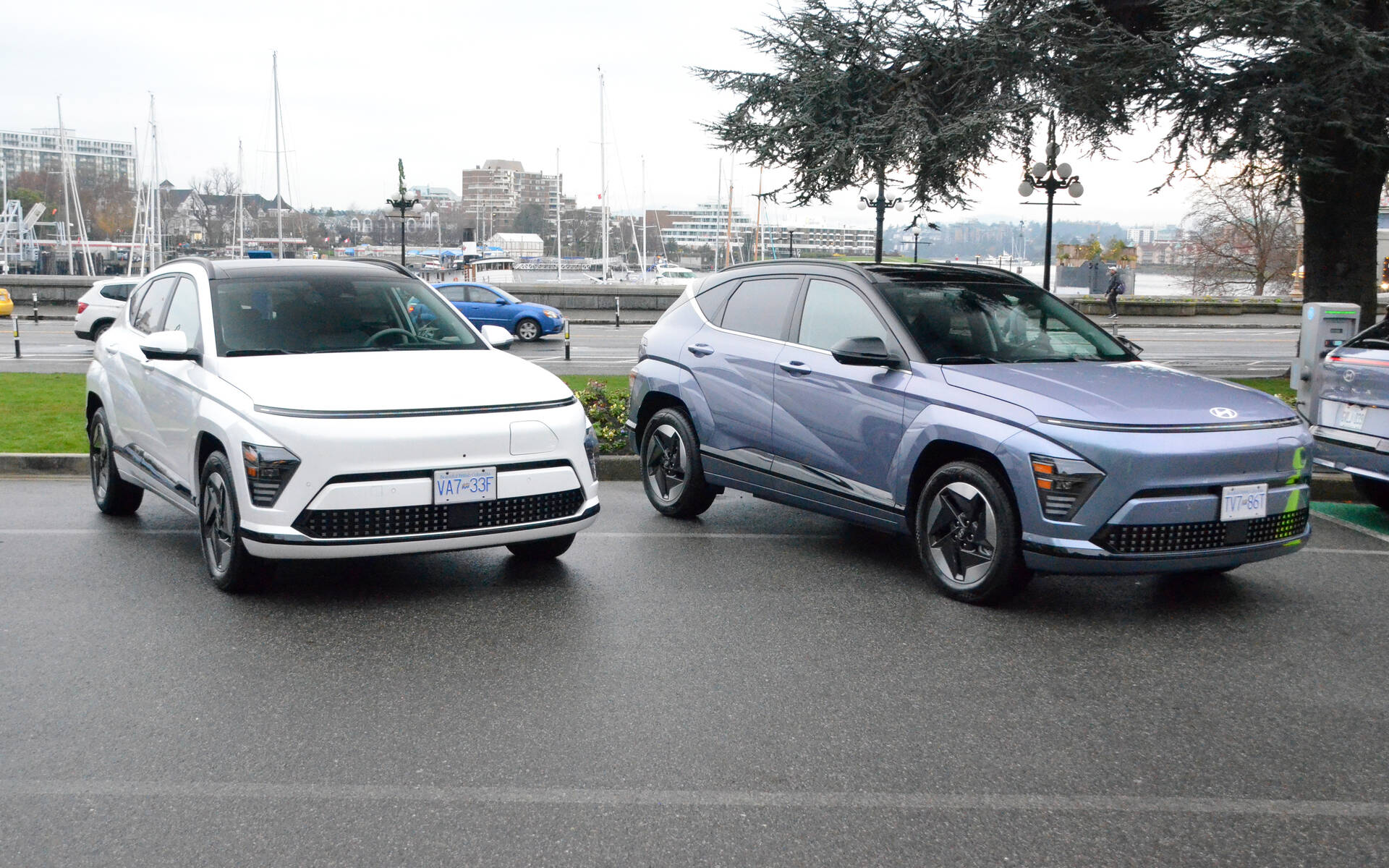
The new variant joins the ranks of the Kona range. It has been on the roads of la Belle Province for several months now. Like its gasoline-powered counterpart, the Kona Electric 2024 retains a highly eccentric silhouette that may not appeal to everyone. One thing's for sure: the designers can't be accused of lacking daring.
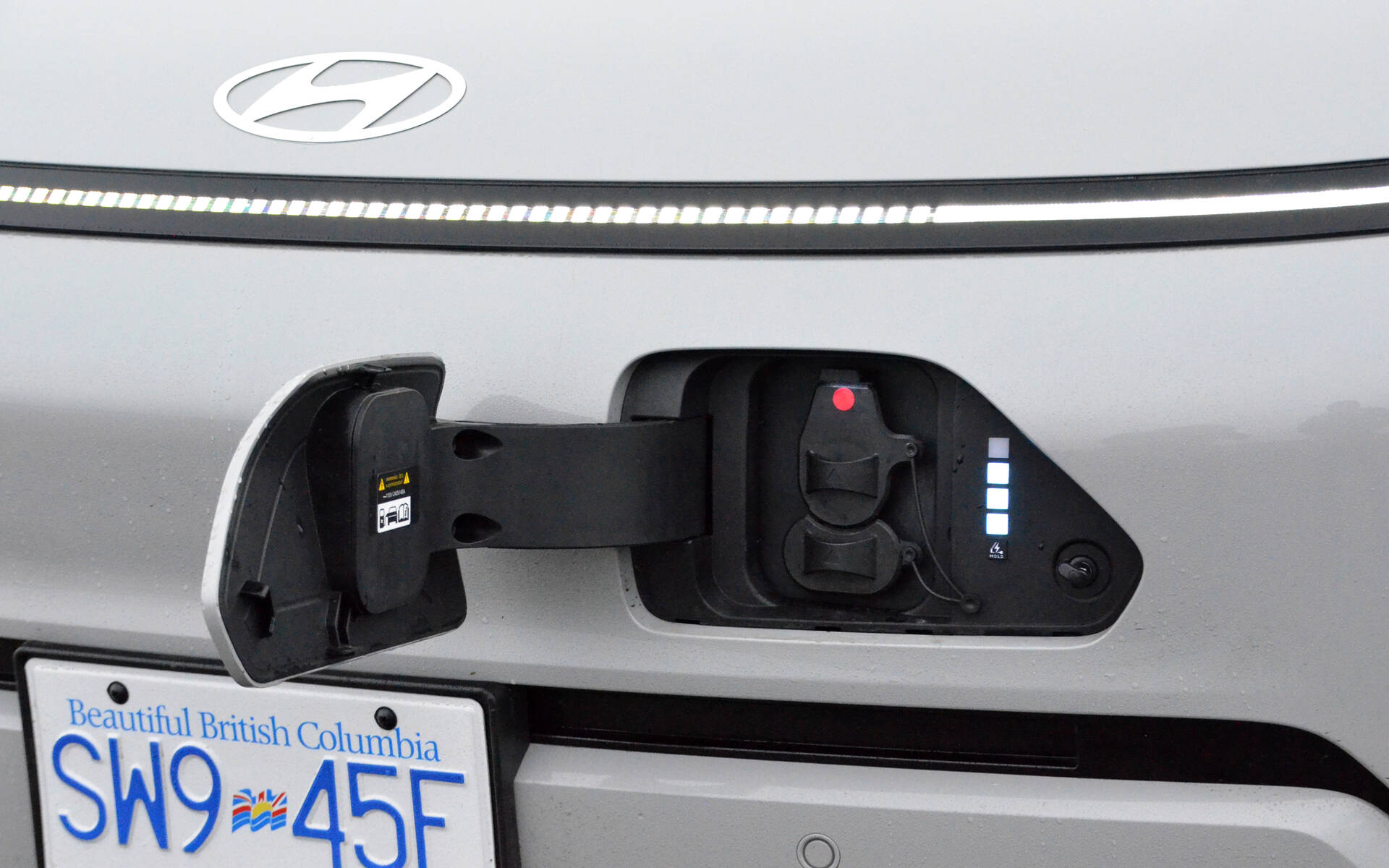
This electric Kona does stand out a little, however, whether by the glossy black stripe running across its lower section, the more closed front bumper, or the abundance of "pixels" further down. Keen observers will already have noticed the presence of a hatch for plugging in the vehicle, which even comes with an integrated heating system to avoid getting stuck in winter. Like the outgoing model, the Kona Electric retains a lower headlamp position, housed in a polygon on either side, while a pixelated light band encircles the base of the hood.
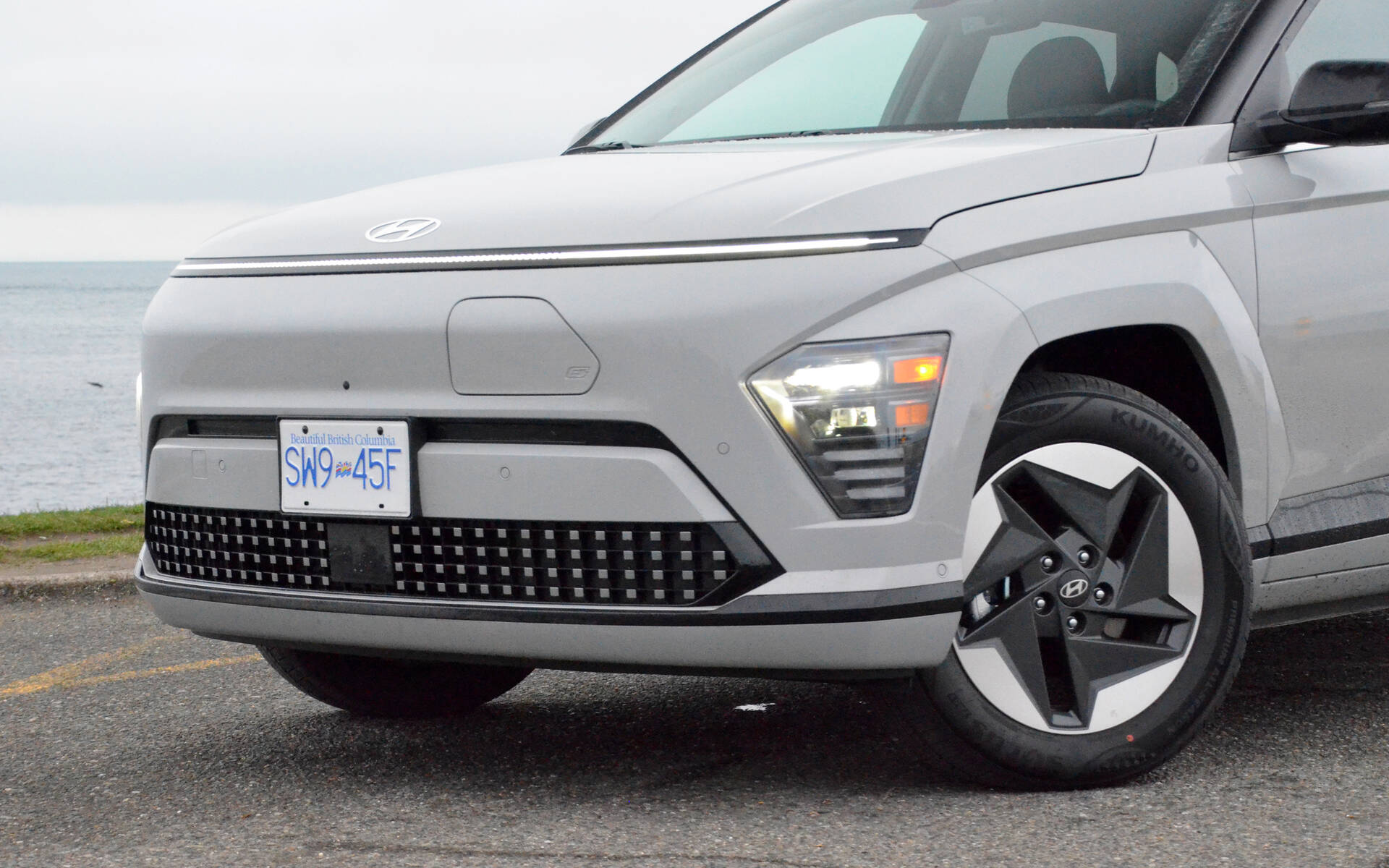
On the flanks, the rounded fenders are joined by ridges arranged in a "Z" shape, as well as a fenestration line that ends in a point at the rear. This fenestration line continues with a small spoiler installed over the rear window. Behind, a mirror effect is created by another horizontal, pixelated strip, accompanied by position lights positioned at the ends of the rear fenders. Finally, aerodynamic 17" wheels are the only wheels offered on both electric models.
Techno atmosphere inside
More and more Hyundai models are being equipped with digital display panels on the dashboard. And the electric Kona is no exception, all the more so as the gasoline variant was already offered with a look similar to recent products such as the Ioniq 5 or Ioniq 6. The steering wheel, with its flattened base, does not feature the usual "H" badge in its center, like the aforementioned models. And as with many new models, the gearshift lever is mounted to the right of the steering column to free up maximum space on the center console, between the passengers in the first row.
Beneath the two-screen pixelated section are a series of traditional controls - thank you Hyundai - for the audio system and air conditioning. Further down, behind the inductive charging tray for smart devices, the designers have grouped together the controls for the heated and ventilated seats, the control for the heated steering wheel, and a thumbwheel for selecting driving modes.
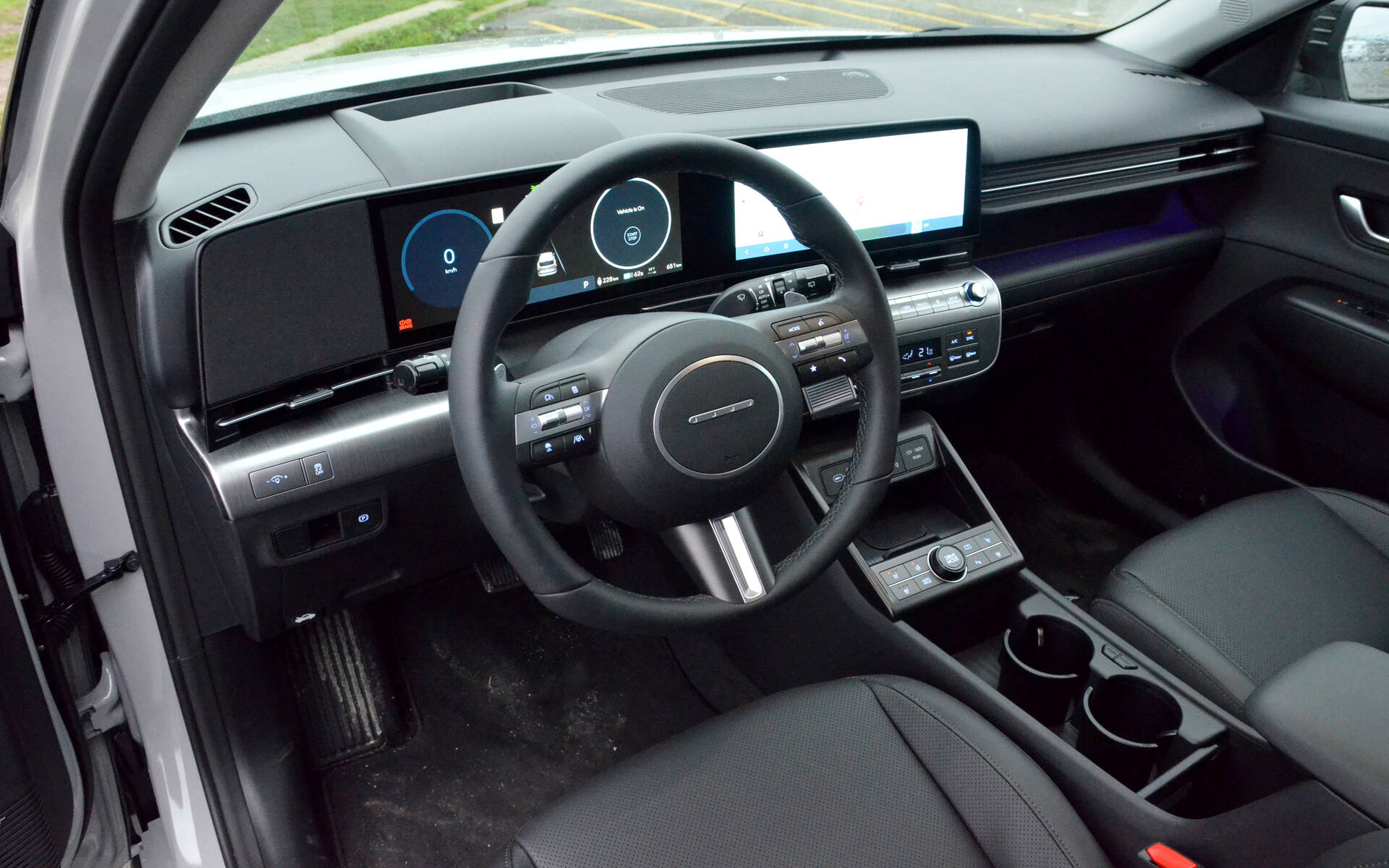
This high-tech ambience does not prevent the presence of hard plastics on the dashboard, center console and door panels... This is not a serious fault, even if it's fair to criticize this choice given the asking price. On the other hand, this type of covering is easy to clean.
A larger Kona
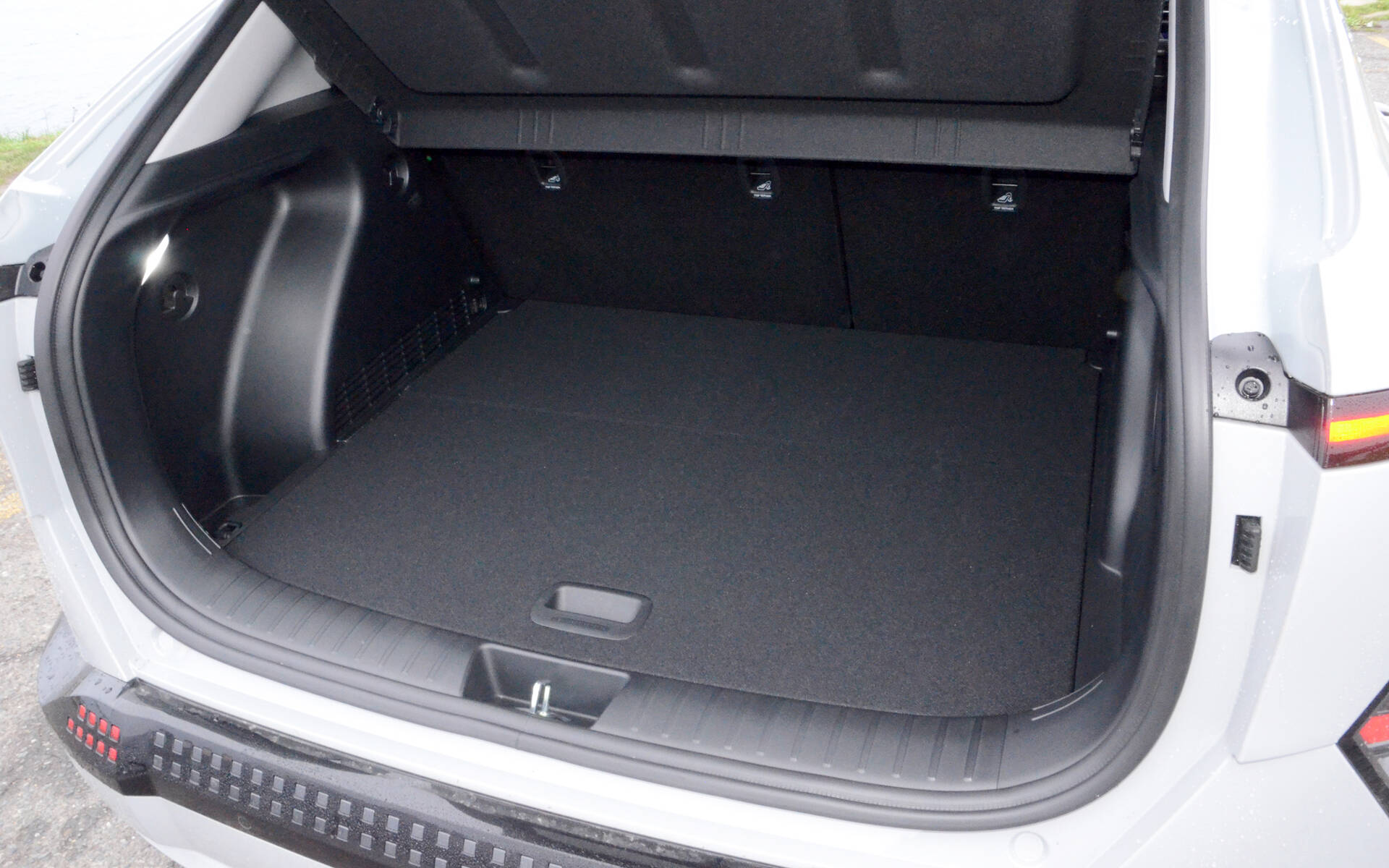
Based on a new platform, the Kona Electric 2.0, unlike its predecessor, was initially designed to accommodate an electric powertrain. The internal combustion variant was subsequently adapted for both gasoline engines. Beyond this design detail, it's in terms of dimensions that the Kona proves more interesting than the one it replaces. While the gain is evolutionary in several respects, the Kona's trunk is larger than in the past. The manufacturer even speaks of a 33% increase. To the naked eye, it's immediately apparent that more can be swallowed up by the cargo space. A few extra liters are available under the floor to conceal items that need to be kept out of sight.
Behind the wheel
Featuring almost identical "mechanics" to the previous Kona Electric, the new model doesn't promise to be any faster: 201 hp and 188 lb-ft of torque, less than the torque of the old version (291 lb-ft). A simple test confirmed the lack of torque from a standing start. On a soggy, cold road, the Kona Electric 2024 hardly spun its front wheels at all - quite the opposite of the old version, which could easily blow its front tires to smithereens. Of course, this test was only possible with traction control deactivated.
With its unchanged power output and slightly heavier weight, the Kona Electric 2024 is no adrenalin merchant, unlike the plush versions of the Ioniq 5 and 6. On the other hand, its mission is not to offer mind-boggling performance, but to weave its way through heavy traffic without emitting a single emission. The only music coming out of the Kona Electric is similar to that emitted by many EVs on the market, a very "electronic" sound that doesn't disturb the neighborhood too much.
On the beautiful winding roads of the Victoria region, the crossover demonstrated once again that its new platform is more comfortable than the old one. The Kona Electric is downright plush for a compact crossover, regardless of the driving mode selected. The steering, meanwhile, is precise enough that the driver doesn't have to work too hard in more demanding situations. Despite this, the fact that the vehicle is limited to front-wheel drive - and that its tires are low rolling resistance - proved problematic in certain situations where the road surface was slippery. In these corners, we had to reduce the pace to allow the front axle to bite into the fresh asphalt in early December.
Of course, we weren't able to test the vehicle's range, but the display showed a distance of 330 km on a morning when the mercury was 5°C. On the other hand, consumption averaged 17.3 kWh/100 km, exactly 1 kWh more than the city average calculated by Natural Resources Canada. A smoother ride and the omission of Sport mode would probably have had a beneficial effect on fuel consumption. However, this average is already quite acceptable, given the numerous accelerations accumulated during the day.
The verdict
At an MSRP of $46,399 for the Preferred livery or $51,199 for the Ultimate edition, the electric Kona is already more attractive than the Ioniq 5, if only for the asking price. The Ioniq 5 in its simplest form starts at $54,999. The less expensive Kona Electric remains an excellent deal in our eyes, not least because it enjoys the same benefits as the second generation: heat pump, identical rims and screens, front hatch heating and that suite of safety features.
As for the Kona Electric Ultimate, it adds a few new features that we weren't able to test during this first contact, including a digital key that can even be shared remotely. Another innovation on board the Kona Electric 2024 is a battery preconditioning system for very hot or very cold days, which speeds up the recharging process.
With the withdrawal of certain affordable electric models - Chevrolet Bolt EV or Kia Soul electric, for example - Hyundai could well increase its market share in this niche.