

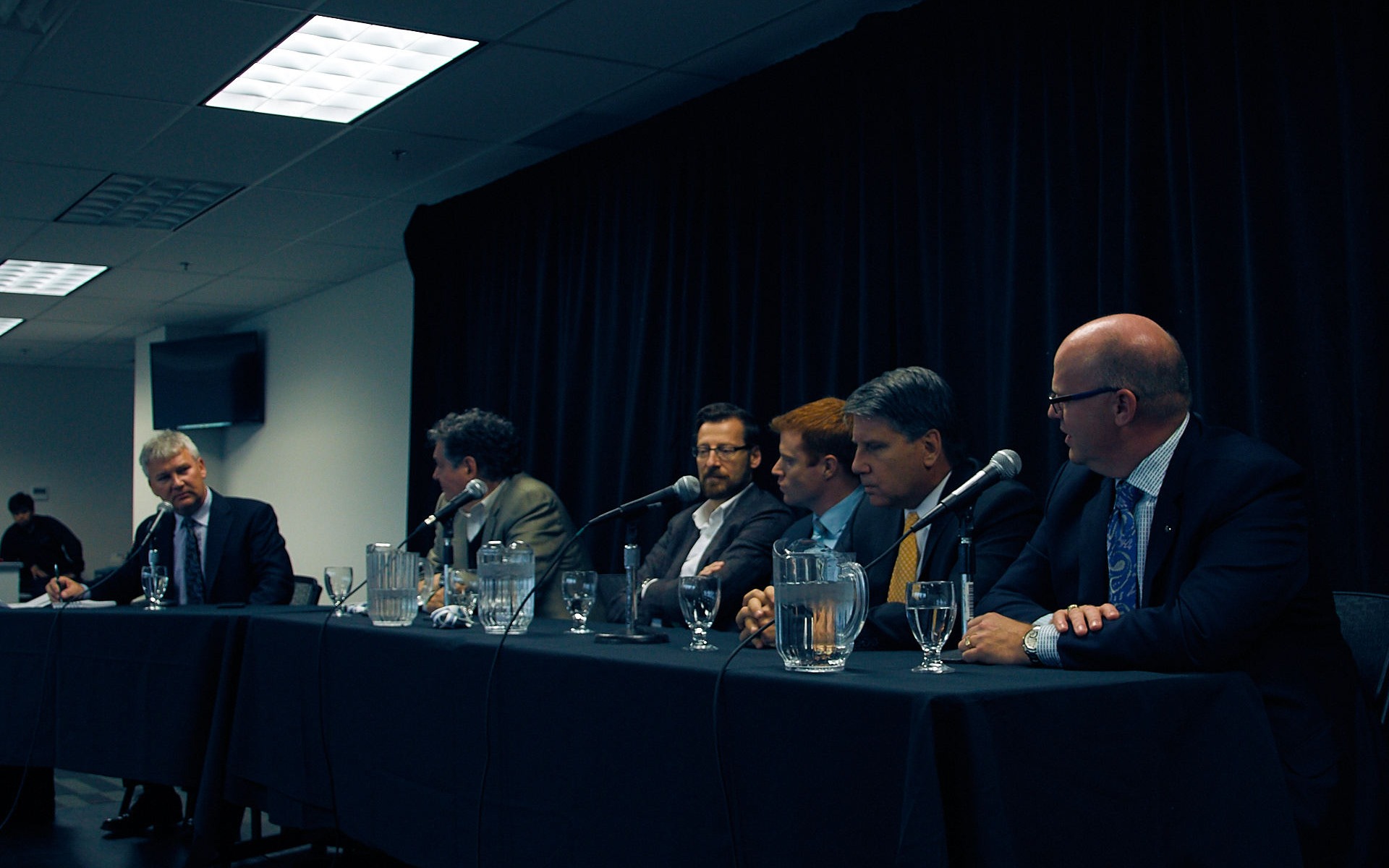
The future according to General Motors, Hyundai, Jaguar Land Rover, Kia and Nissan
David Paterson, vice president of public affairs and environment, General Motors of Canada; Wolfgang Hoffmann, president, Jaguar Land Rover Canada; François Lefèvre, chief marketing manager, LEAF, Nissan Canada; Don Romano, president and CEO, Hyundai Auto Canada Corp. and Ted Lancaster, vice president and chief operating officer, Kia Canada. As part of a panel discussion with journalists who are members of the Automobile Journalists Association of Canada, they spoke on a number of issues, both current and future.
Electric cars
First of all, the electrification of transportation. On the optimistic side, Chevrolet, Jaguar and Nissan are investing in this technology. Chevrolet Bolt EV, right?
Hyundai Canada, on the other hand, is a bit more skeptical. The company's president, Don Romano, doesn't believe in electric cars in the short term. He says, and I quote, "The batteries aren't there yet. If you want to get to Montreal from Toronto, you have to stop on the way. In the meantime, there are hydrogen fuel cells... In 5 minutes, you fill up your car, which gives you enough autonomy to drive more than 500 km."
Will the hydrogen car for the masses, a solution with questionable fuel efficiency, ever see the light of day? By the time a real hydrogen recharging infrastructure is in place, electric cells could provide nearly 800 km of autonomy. But that's just the opinion of yours truly!
At Kia, however, Ted Lancaster acknowledged that it's mostly about charging infrastructure. By 2020, the brand wants to improve the overall fuel efficiency of its cars by 25%. Speaking about the new zero emission law adopted in Quebec, he is waiting for more details before making a statement, as the law does not yet clearly specify the terms.
Mr. GM, David Paterson, reminded us that it is the consumers who choose. They are the ones who need to be convinced. A law that forces electrification tends to be disconnected from them, which is not a good thing.
In the end, the manufacturers established the consensus that demand will determine the future, not government and their laws. We need to provide informed options to consumers. The government needs to not only give rebates to consumers, but also see that the infrastructure is put in place, whether it is electric or hydrogen.
Connectivity
There is a demand for more technology in cars, but also for more safety. What is the balance between these two aspects?
Kia addresses the issue of autonomous cars, and liability. An autonomous Kia causes an accident. Is it the fault of the driver, the car, the brand? A question to be addressed in the coming years, according to Lancaster. For now, Kia wants to make the roads safer. There also needs to be a mechanism to ensure some privacy for drivers, so that car companies can't track their customers' movements with impunity.
At Hyundai, Don Romano doesn't believe he'll see autonomous cars on our roads in the next five years. He believes he will see them eventually, but as part of an evolutionary process, where the technologies will enter quietly. Hyundai is also focusing on increasing connectivity between its vehicles and its headquarters, so that Hyundai cars will be more intelligent and thus able to warn drivers of upcoming hazards.
Nissan has ambitious goals, which are to offer semi-autonomous vehicles, or even near total autonomy, within a few years. Nissan aims to bring safer cars to the market.
Jaguar wonders how important it is to have autonomous cars in the immediate future. It's not essential, after all. According to the British brand, it would be a marketing sham that some would use to sell cars. Mr. Hoffman would love to see someone driving his car, taking a mountain pass in the Alps while reading a book... But in the end, the person behind the wheel would be responsible. He believes that people should remain in control of their cars, and that Canada should do a better job of educating the public that it is in the left lane that you can pass on the highway. All of this is said with a nice touch of humour, which barely hides Jaguar Land Rover's delays in this regard.
As for Chevrolet, the company reportedly has 30 autonomous cars on U.S. roads right now, testing their various technologies. Paterson believes that manufacturers need to focus on a multitude of safety technologies. There are 35,000 deaths a year in North America due to human error, and we need to reduce that number to zero. In five years, he believes we will be looking at 10-year-old cars, and they will be considered unsafe.
Carsharing
What is the future of personal transportation?
GM believes that in urban centers, people will get a car from their cell phone as a service, not as a possession. That's why GM has created a company called Maven, which is working on a number of ways to encourage car-sharing, such as a condo building that would include in its condo fees a subscription to a service where you could borrow GM cars, as needed. No more need to own a car.
At Jaguar Land Rover, a luxury company, there is little desire to share a sports car with strangers. In his case, there's not really a demand from the typical customer for it. However, Hoffman sees this kind of technology as important in downtown areas where parking is becoming increasingly scarce. In fact, he sees Uber pushing autonomy to alleviate a driver shortage. He believes that some people will always seek the pleasure of driving, as well as the power to leave whenever they want, without having to wait for a car to become available.
As for Nissan, it is piloting a few projects around the world on platforms similar to Uber, but not necessarily in Canada. However, Mr. Lefèvre recognizes the need for this type of technology.
Mr. Romano of Hyundai is not very optimistic about the technology. He believes that as young people grow up, who are heavy users of Uber, they will see the need to have their own car. Much like Jaguar, people will prefer to go where they want, when they want, and owning a car will continue to be part of people's desires. However, he admits that in the context of large, traffic-congested cities, there is a place for this type of service.
At Kia, we talk about the fact that life expectancy in Canada is now 77 years old, which is more or less accurate. However, it is true that our aging population, living outside the cities, will need to get around, and owning a car is not possible for all these people. For them, the possibility of having an "Uber-like" car service to help these people makes sense. In addition, Lancaster points out that the generation we are talking about is buying less and less.
These are interesting visions of the years to come, but history teaches us that no one is immune to the imponderables of progress. Perhaps Elon Musk will succeed in his gamble, and force the adoption of autonomous electric cars. Perhaps, even, a new Elon Musk will take humanity and its means of transportation in a completely different direction.
But then again, Robur, a character from the writer Jules Verne, said that "it is evolutions, not revolutions that should be made." In other words, you have to be of your time. It would seem that our five guests have read the work of Mr. Verne, since they all abound in this direction.