

Hyundai Santa Fe 2024: South Korea takes inspiration from Dearborn
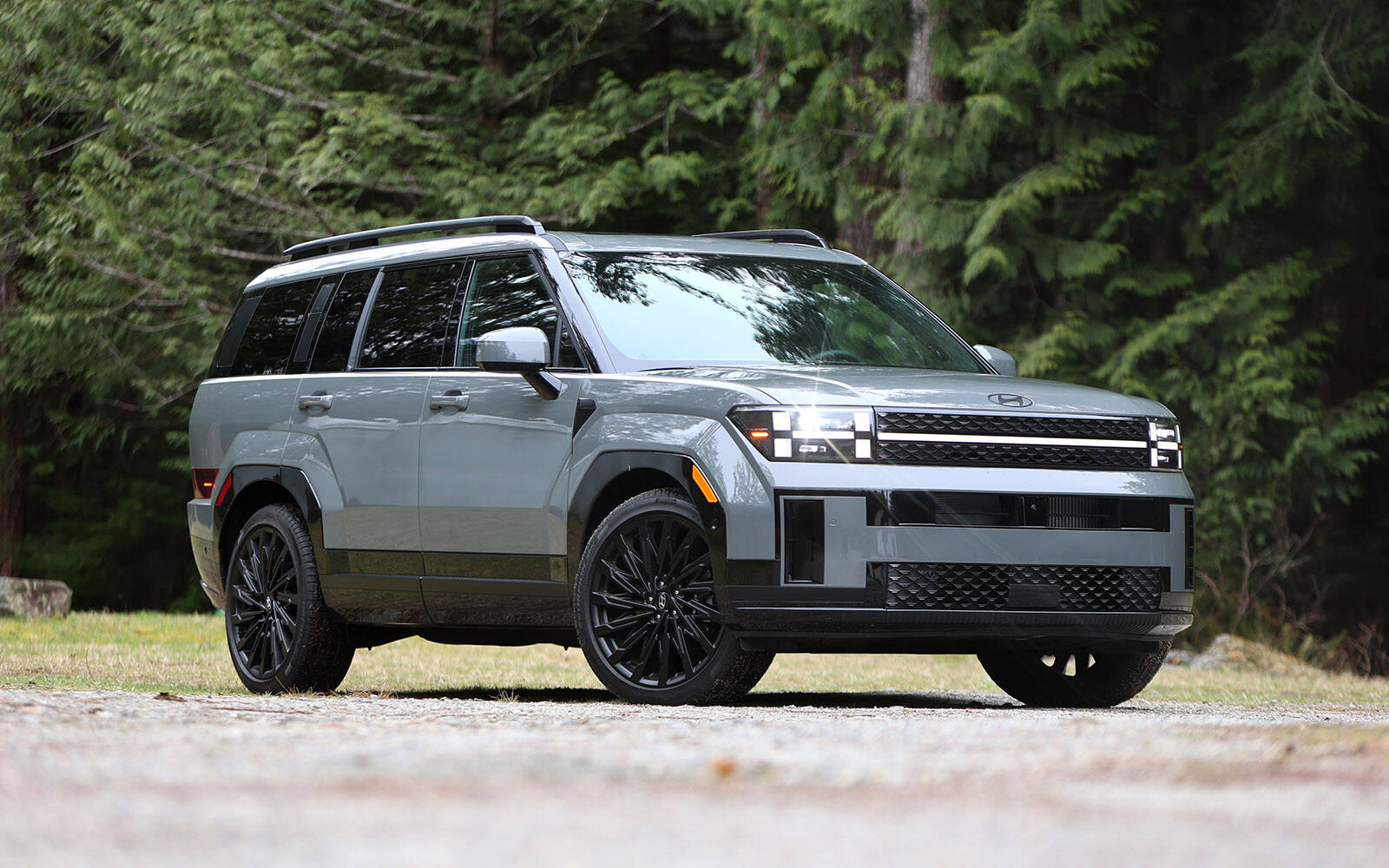
Can we speak of a reincarnation? A revival? Or simply a stylistic inspiration so strong that it can be confusing from certain angles? Of course, we're talking here about the Ford Flex, whose essential design features can be found on this new-generation Hyundai Santa Fe, truly distinct from the model it replaces.
A product that, until now, had been functional but lacked personality. An identity so weak that it could be passed off as a product of just about any brand.
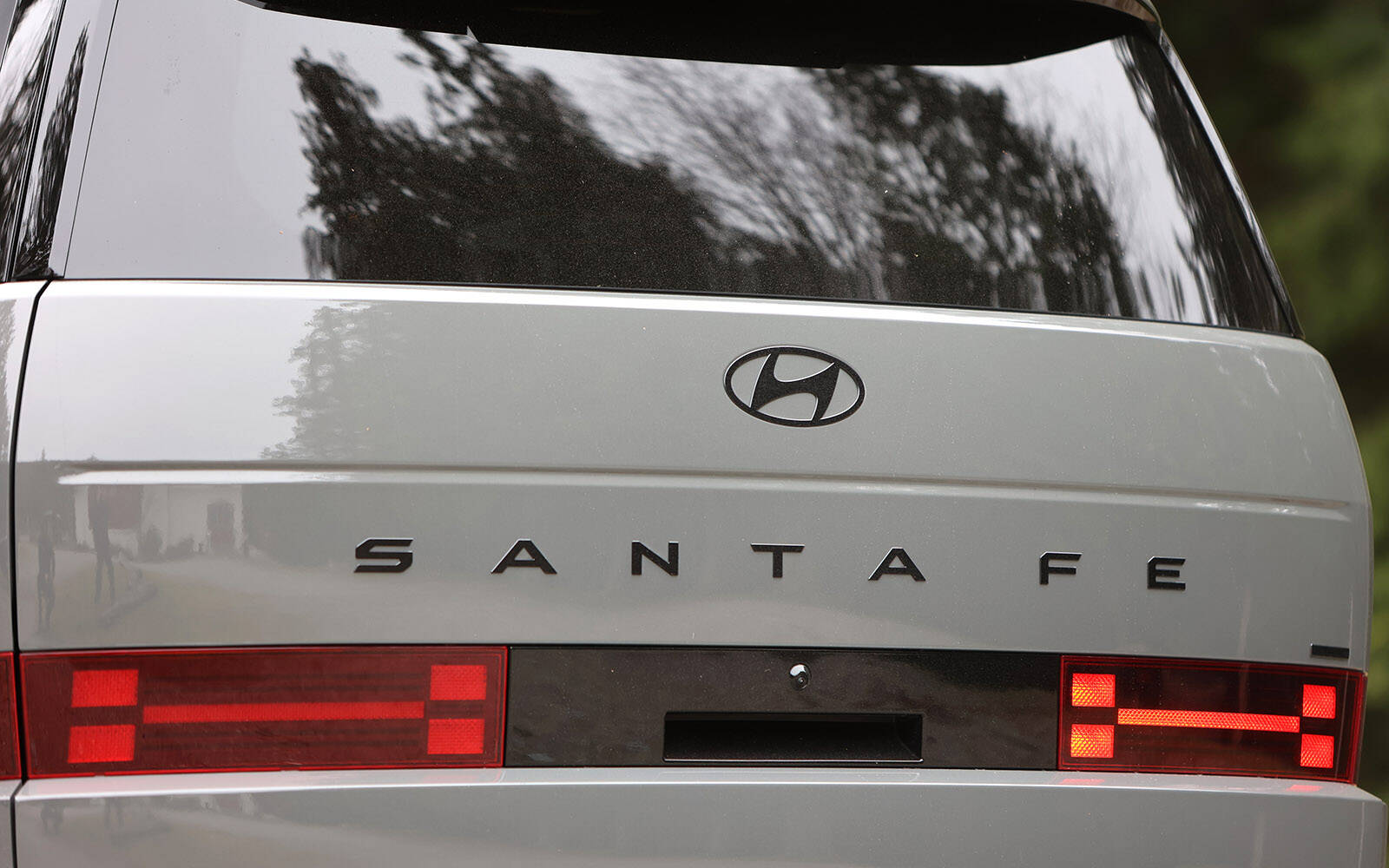
The fifth-generation Santa Fe is a real eye-catcher, to say the least. With angular, split lines, characterized by headlights and taillights where the H (Hyundai) comes to the fore. Will some see it as a Honda, or even a Hummer? Who knows? But one thing's for sure: this Hyundai doesn't look like any other product from the brand, and is now very clearly differentiated from its little brother, the Tucson, which has recently gone from strength to strength.
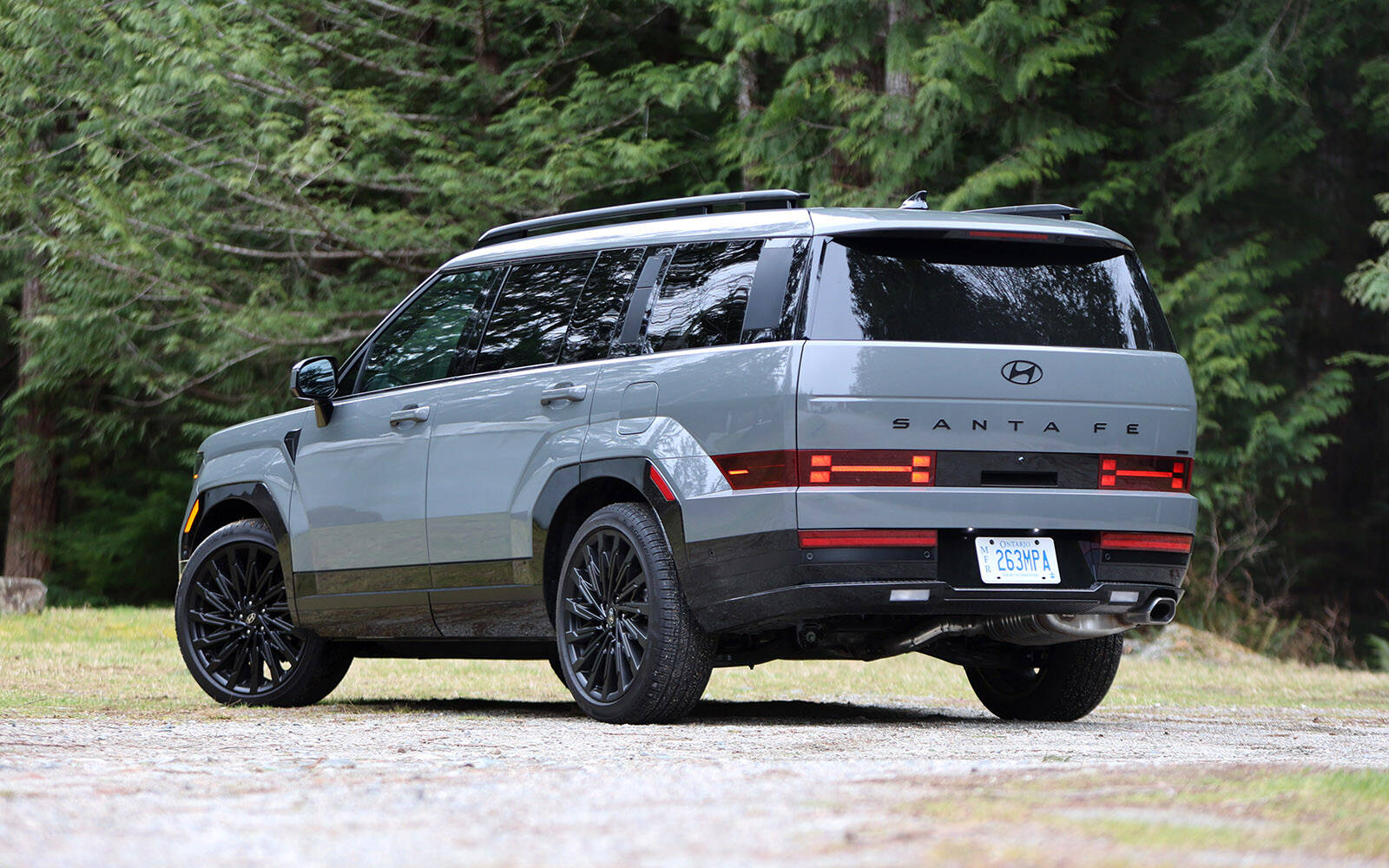
Polarizing, the new Santa Fe is also larger than its predecessor. It is 45 mm longer and 35 mm taller, and provides 120 liters more load volume. It now comes with three rows of seats as standard. Its dimensions and size are midway between those of the Tucson and the Palisade. A vehicle that's said to be more versatile and adventurous, this new XRT version with enhanced suspension and towing capacity of up to 4,500 lb has been created with this in mind.
Hyundai has even gone so far as to integrate an ingeniously concealed handle into the C-pillar, allowing easy climbing to access the roof rack after placing your foot on the rear tire. Because, of course, Hyundai offers a whole range of storage accessories that attach to the roof rack, right down to a tent for expeditionists.
Déjà vu
On board, the dual 12.3-inch display is identical to that on the Ioniq 5, Ioniq 6 and Tucson models. It's slightly angled towards the driver for improved ergonomics, and this time it's accompanied by a third touchscreen for heating and air-conditioning controls.
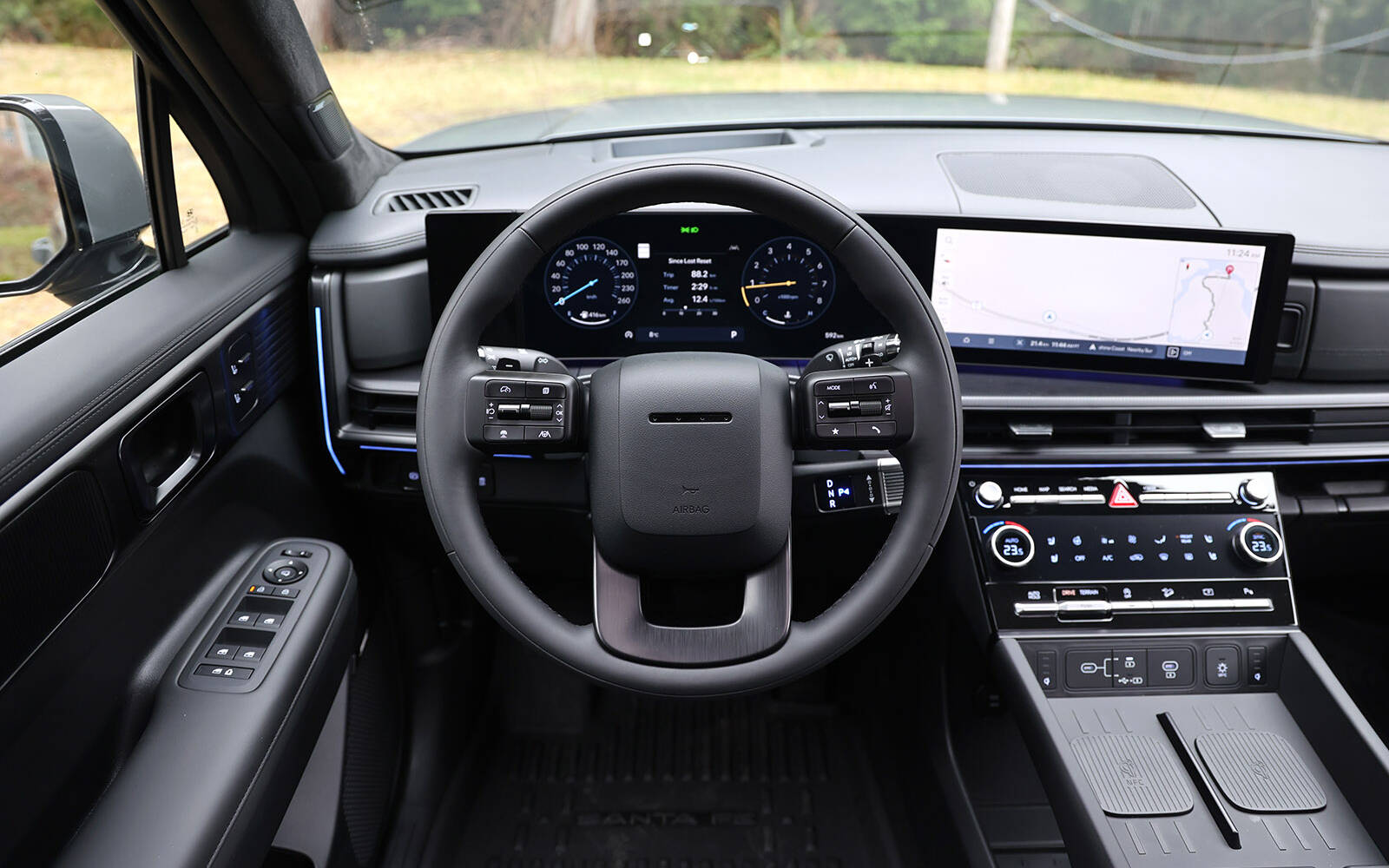
Ergonomics have been finely tuned to make life easier for occupants, who also benefit from countless storage spaces and two wireless charging trays for mobile devices. Hyundai has even gone so far as to integrate an upper glove compartment that can sterilize various objects, such as cell phones and, of course, gloves, using ultraviolet rays. An idea that was born during the pandemic and is no longer considered a purchasing criterion.
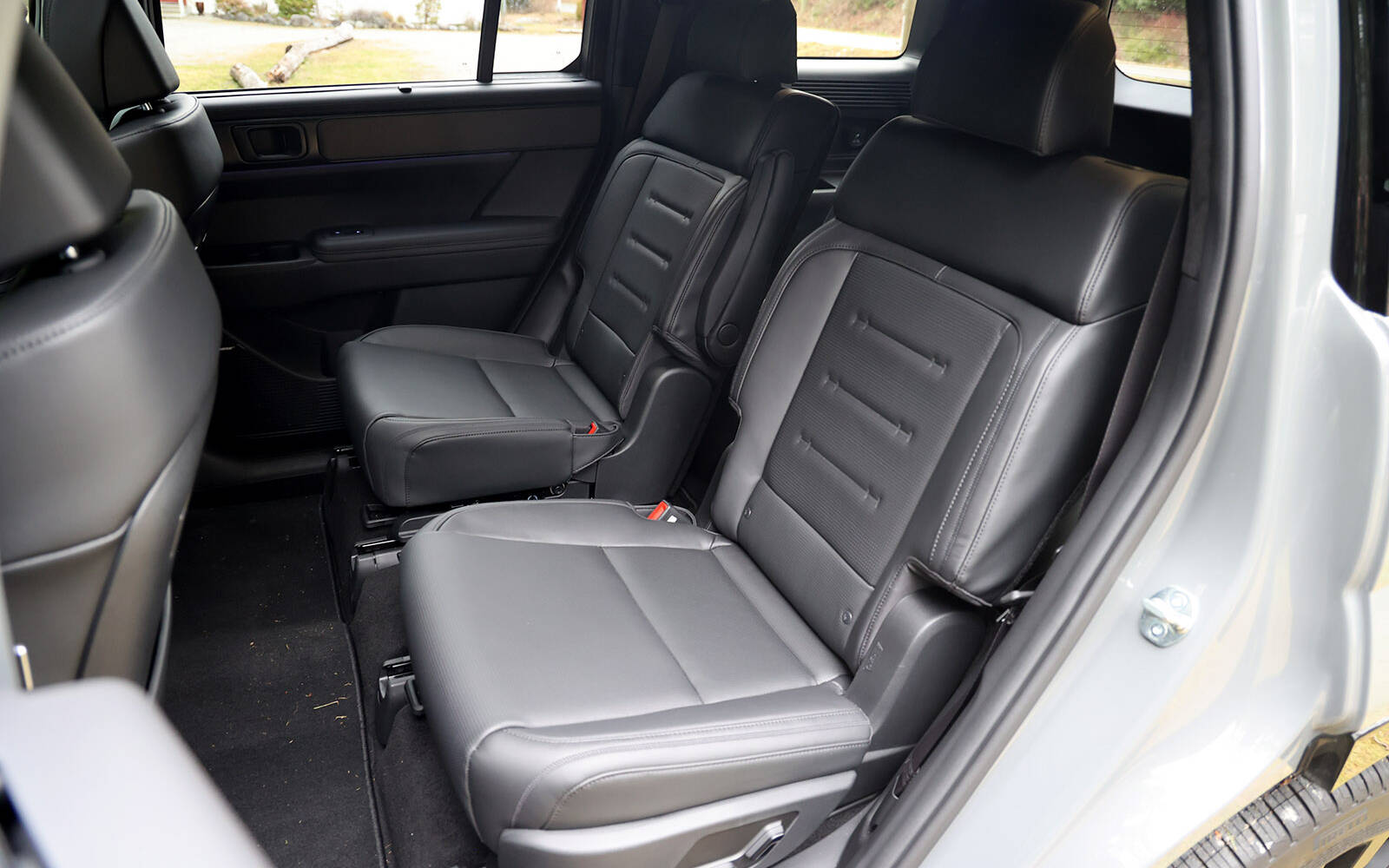
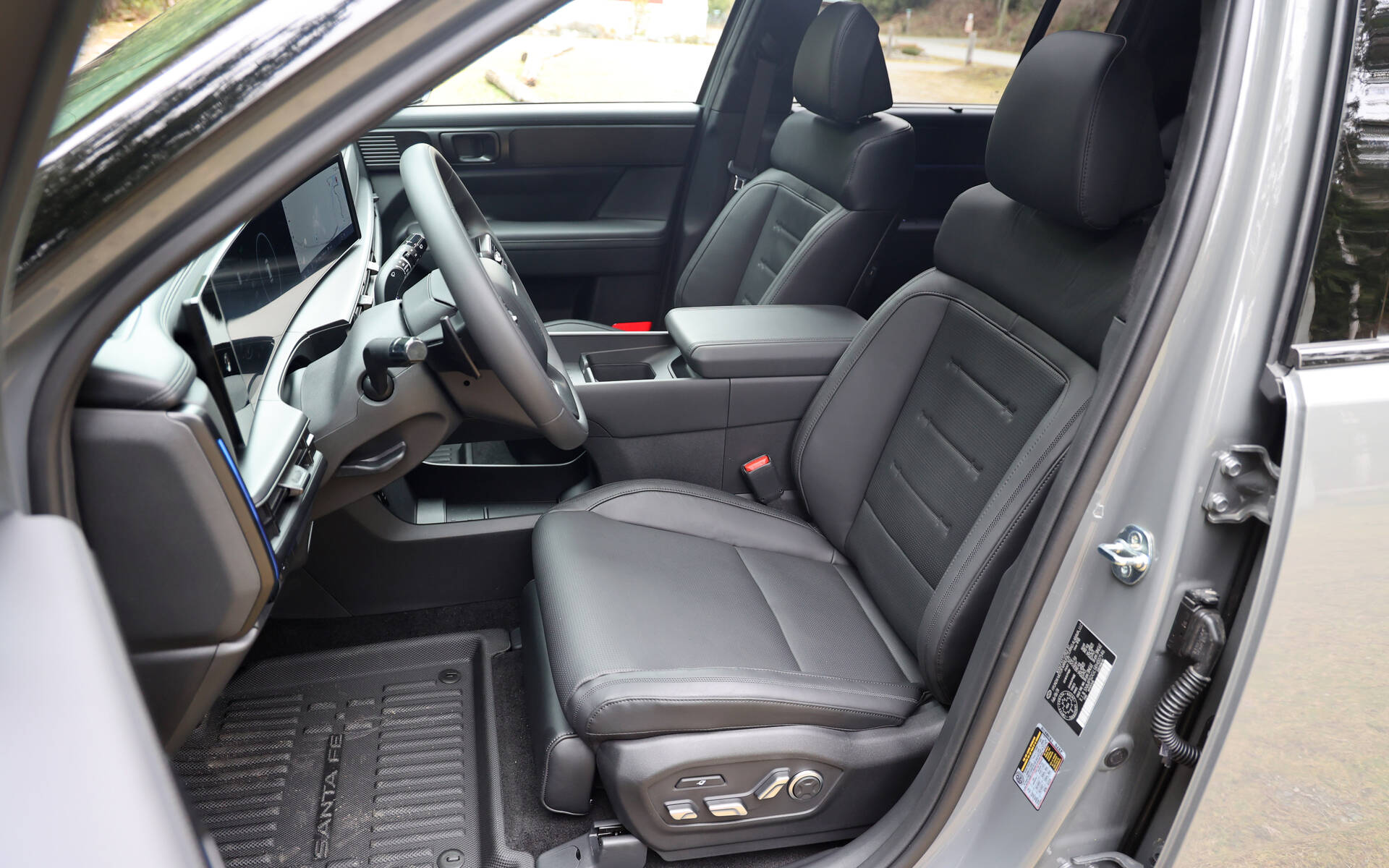
Extremely spacious, the cabin features adjustable ambient lighting on certain models, a blind spot camera on the instrument panel, and a head-up display. The digital key transposed to your cell phone is also an accessory that many will adopt without a shadow of a doubt. That said, only the top-of-the-range Ultimate Calligraphy version offers second-row captain's chairs, reducing the possible number of occupants to six. Otherwise, all versions feature a three-seat bench in the middle row, more versatile for families.
The driver's seat is very comfortable, and he or she feels totally at ease. Visibility is excellent, as is the driving position, giving the impression that the vehicle is more compact than it actually is. Naturally, the Ultimate Calligraphy model boasts above-average luxury and finish, including a footrest integrated into the seat for enhanced relaxation during stops.
Au revoir, hybride rechargeable
Ne soyez pas étonné de voir disparaître l’hybride rechargeable, qui a déçu nombre d’acheteurs dans le passé en raison de sa trop faible diffusion. Une technologie qui selon Hyundai est sur son déclin, les acheteurs préférant se lancer dans l’électrification à 100%. D’ailleurs, Hyundai est sur le point de présenter son Ioniq 7 pour pallier la disparition de la technologie hybride rechargeable, qui demeure pour l’heure disponible qu’avec le Tucson.
A curious strategy if ever there was one, Hyundai has chosen to offer traditional hybrid technology on its entry-level versions, in this case consisting of an electric motor and a 1.6-liter turbocharged four-cylinder mated to a 6-speed automatic gearbox. Producing a maximum combined output of 231 hp, the latter could not be tested at launch.
Hyundai preferred to focus on the 2.5-liter turbocharged engine, which is unfortunately paired with the disappointing dual-clutch sequential gearbox also found on the Santa Cruz pickup. A transmission that's slow to react to the initial start-up, and with which the manufacturer has also experienced a few reliability problems in the past.
It's a pity Hyundai didn't opt for a traditional automatic, which would certainly have been better suited to the vehicle. Moreover, the fuel consumption recorded during the test drive was disappointing, averaging 12.2 L/100 km. Was this due to road conditions? Perhaps, but Hyundai's claimed average of 10.8 L/100 km is also disappointing, especially when you consider that for 277 hp (i.e. 46 extra hp), on paper you consume 40% more petrol than with the hybrid.
Fitted in the XRT, Luxury and Ultimate Calligraphy versions, this 2.5-liter engine even consumes 15% more fuel than the inline six-cylinder of the recent, more powerful and more pleasant Mazda CX-90. This is the disappointing element of this model, which becomes much more attractive in its entry-level hybrid variants. Hyundai will soon be launching a special edition in NHL (National Hockey League) livery, offering the hybrid powertrain and all the luxury of the Ultimate Calligraphy version. A model that is likely to be coveted, especially by parents who (like me) drive their son to the arena several times a week.
XRT for adventure
AT4, TrailSport, RockCreek, Timberline, Wilderness, TRD Off-Road are versions designed by their respective manufacturers to give buyers an impression of invincibility. But basically, they're not designed to climb Everest. However, because the formula works, Hyundai has chosen to adhere to it this year with the introduction of the Santa Fe XRT. A model with a one-inch higher suspension, more aggressive tires and 18-inch wheels, it stands out aesthetically and has better towing capacity. It's entry-level for the 2.5-liter turbocharged engine, but represents a great value for buyers looking for greater versatility.
Priced at $48,999, including transport and preparation costs, this version could be quite successful here, considering that its comfort is only slightly affected by its timid mechanical modifications. Mind you, we can expect the Preferred version with Trend package and hybrid powertrain, priced at $2,000 less, to be equally popular. Especially considering its claimed fuel consumption of 6.9 L/100 km.
In the end, the Santa Fe 2024 won't win unanimous approval and disappoints in certain respects, but it stands out more than in the past and could therefore appeal to more buyers.