

All-wheel or four-wheel drive: what's the difference?
All-wheel drive and four-wheel drive vehicles are more popular than ever with Canadian drivers, not least because the price gap at the point of purchase and at the pump has narrowed considerably.
Some people use the terms interchangeably, but there are differences between all-wheel drive (AWD) and four-wheel drive (4x4). What are they? Let's find out here.
AWD
First, let's start with all-wheel drive, a system designed for cars and SUVs with a primarily urban vocation, and therefore much better suited to everyday life.
Activated automatically, the system often favors fuel economy by operating a single axle under normal conditions. It transfers part of the torque to the other axle, depending on road conditions and driving style, to increase grip.
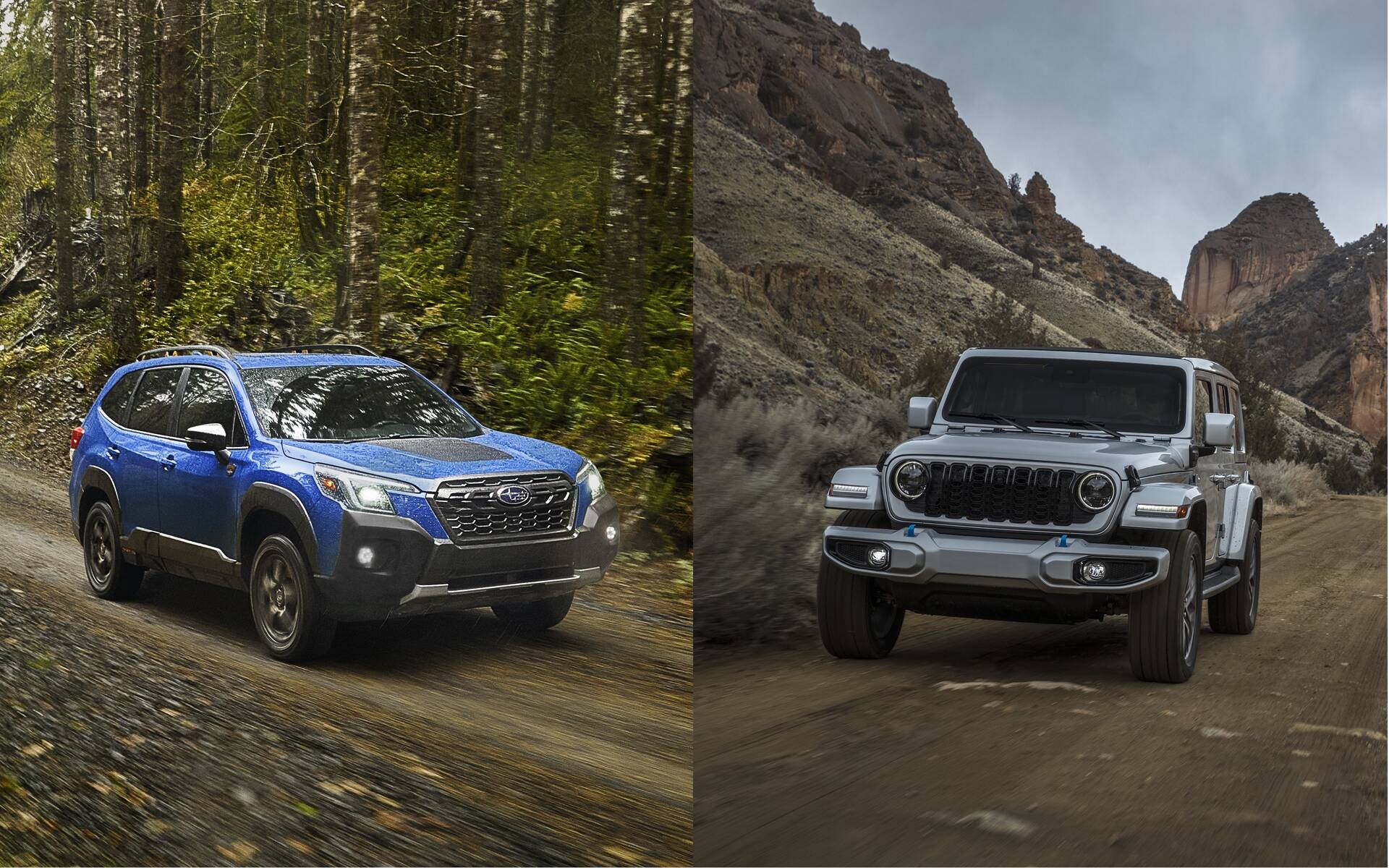
At Subaru, for example, we talk about a constant-mesh all-wheel drive system, as all four wheels provide driving power at all times. And when we speak of torque vectoring, we mean that the system can transfer torque from left to right between the rear wheels, optimizing cornering performance. Acura's SH-AWD is just one of many.
Electric vehicles with two or more motors also benefit from an all-wheel drive, with one motor driving the front wheels and the other the rear wheels.
4x4
Four-wheel drive systems are typically found on off-road trucks and SUVs, such as those from Jeep. Since they are not permanently active, the driver has the task of manually alternating between 2x4 and 4x4 modes using a console-mounted selector.
In simple terms, the engine sends its torque to a transfer case which distributes it evenly to all four wheels, i.e. 50% to the front and 50% to the rear. This gearbox generally comprises a high range (4Hi) and a low range (4Lo), the latter being designed for low-speed travel, for example in rougher or muddier terrain, or even when climbing out of a snowbank.
This type of system is highly effective off-road or in extreme conditions, where optimum grip is required. However, it is less advantageous at higher speeds and in tight bends, as the wheels cannot turn at different speeds. That's why it's preferable to drive in 2x4 mode in normal conditions.
Don't neglect your tires!
In conclusion, whatever the type of system, the idea is to increase traction and stability on different types of roads - rain, snow, ice, earth, gravel, mud, etc. - and to reduce the risk of accidents. Compared to simple front- or rear-wheel drive, this is a considerable advantage for the driver, but don't forget that quality tires are just as important, if not more so.